
Blog
IRS Qualified Appraiser Requirements: How to Vet an Appraiser Before Filing Form 8283
Not every credentialed appraiser meets the IRS bar for a charitable donation appraisal. Here is exactly what Treas. Reg. 1.170A-17 requires, who is excluded for conflicts of interest, and how to vet a candidate before you file Form 8283.
Donating property worth more than $5,000 sounds simple until the IRS asks who signed the appraisal. Not every appraiser meets the federal definition of "qualified," and hiring the wrong one can get your entire deduction disallowed, even if the number on the report is accurate. This guide walks through the actual IRS standard for a qualified appraiser, the independence rules that disqualify certain people outright, what has to be attached to Form 8283, and a practical checklist you can use before you ever sign an engagement letter.
What Does the IRS Mean by a "Qualified Appraiser"?
A qualified appraiser, under IRS rules, is someone with verifiable education and experience valuing the specific type of property being donated, who performs appraisals regularly for pay, and who has no financial or personal stake in the outcome of the donation. This standard comes directly from Treasury Regulation 1.170A-17, the operative federal rule behind IRC Section 170(f)(11)(E).
The key word is verifiable. The IRS is not looking for a general sense that someone "knows antiques" or "has an eye" for value. It wants documented education and experience tied to the exact category of property in the donation. An appraiser who specializes in fine art cannot sign off on a donated tractor, and an equipment appraiser cannot value a coin collection, no matter how many years either has been in business.
If you are donating household goods, artwork, or collectibles, our personal property appraisal for charitable donation service is built around exactly this standard: a credentialed specialist matched to the property type, working within IRS timing and documentation rules from the start.
The Education and Experience Requirement
An appraiser satisfies the IRS education and experience test one of two ways: by earning a designation from a recognized professional appraiser organization for that property type, or by completing relevant coursework and accumulating at least two years of hands-on experience valuing that same category of property. Both paths lead to the same legal outcome; neither one alone is automatically sufficient without the underlying substance behind it.
According to a summary of the statutory framework from The Tax Adviser, the appraiser must also regularly perform appraisals for compensation, demonstrate verifiable expertise in the specific property type, and not have been barred from practicing before the IRS at any point in the three years before signing the appraisal. A hobbyist who values items casually for friends, even a knowledgeable one, does not meet this bar.
In practice, this is where credentials matter. Appraisers commonly hold designations through organizations such as the International Society of Appraisers (ISA), the American Society of Appraisers (ASA), or the Appraisers Association of America (AAA), and prepare reports in accordance with the Uniform Standards of Professional Appraisal Practice (USPAP), published by The Appraisal Foundation. None of these credentials is legally required by name, but each demonstrates the kind of documented training and testing the regulation is looking for.
Pro tip: Ask a candidate appraiser how many appraisals of your specific property type they have completed in the last two years, not just how many appraisals overall. The IRS standard is property-specific, and so should your due diligence be.
The Independence Rule: Who Can't Appraise Your Donation
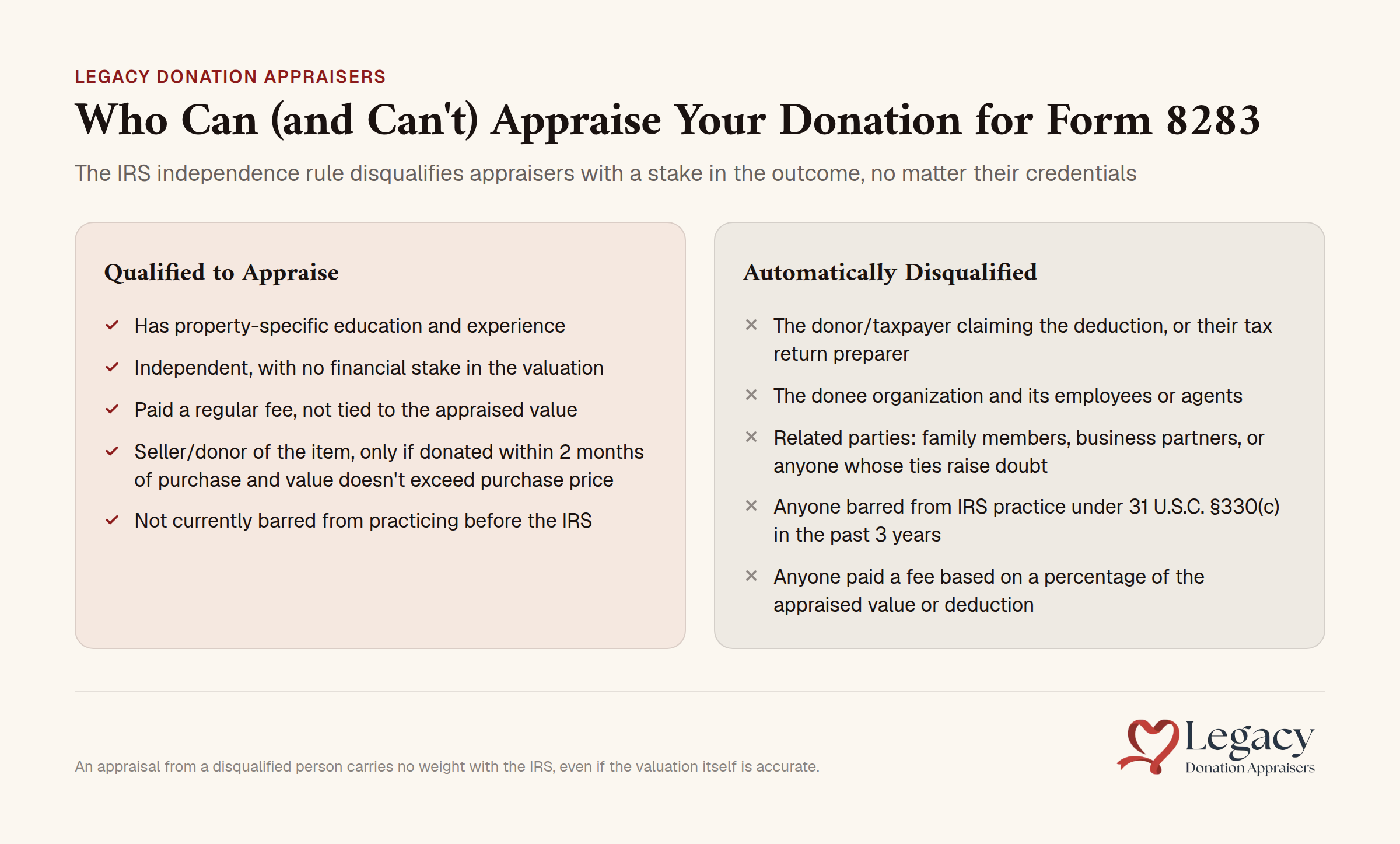
The IRS disqualifies anyone whose relationship to the donation could create an incentive to inflate the value, regardless of how well-credentialed they are. This is a separate test from the education and experience requirement, and failing it disqualifies an otherwise perfectly qualified appraiser.
The following individuals cannot serve as the qualified appraiser for your donation:
- The donor or taxpayer claiming the deduction, or anyone who prepared the donor's tax return
- The donee organization and any of its employees or agents
- Parties related to the donor, including family members and business partners, or anyone whose relationship to the transaction would cause a reasonable person to question independence
- Anyone barred from practicing before the IRS under section 330(c) of title 31 of the U.S. Code within the three years before signing the appraisal
- Anyone paid a prohibited appraisal fee, meaning a fee based on a percentage of the appraised value or the size of the resulting deduction
There is one narrow exception worth knowing: a person who sold, exchanged, or gave the property to the donor may sign the appraisal if the donation happens within two months of the donor acquiring it, and the appraised value does not exceed the original purchase price. Outside that specific scenario, any of the relationships above disqualifies the appraiser entirely, and an appraisal from a disqualified person carries no weight with the IRS even if the valuation itself is defensible.
What Must Be Attached to Form 8283
A qualified appraisal has to include specific information, and the appraiser has to personally complete a declaration on Form 8283 stating why they are qualified for this particular assignment. It is not enough for the appraiser to simply state a value; the IRS wants a paper trail showing how they got there and why they were the right person to do it.
At minimum, the appraiser must provide:
- A signed and dated Declaration of Appraiser on Form 8283, Section B, Part III, stating their background, education, experience, and any professional memberships that qualify them for this type of property
- A description of their qualifications specific to the property being valued, not a general resume
- The appraisal itself, describing the property, the valuation method used, and the effective date of value
- Their signature and the appraisal date, which must fall within the required timing window discussed below
More than one appraiser can value a single donation, as long as each one signs the declaration and meets the qualification standard independently. This comes up on larger donations involving mixed property types, where no single appraiser has expertise across every category.
Filing Thresholds and Timing: What Triggers Which Requirement
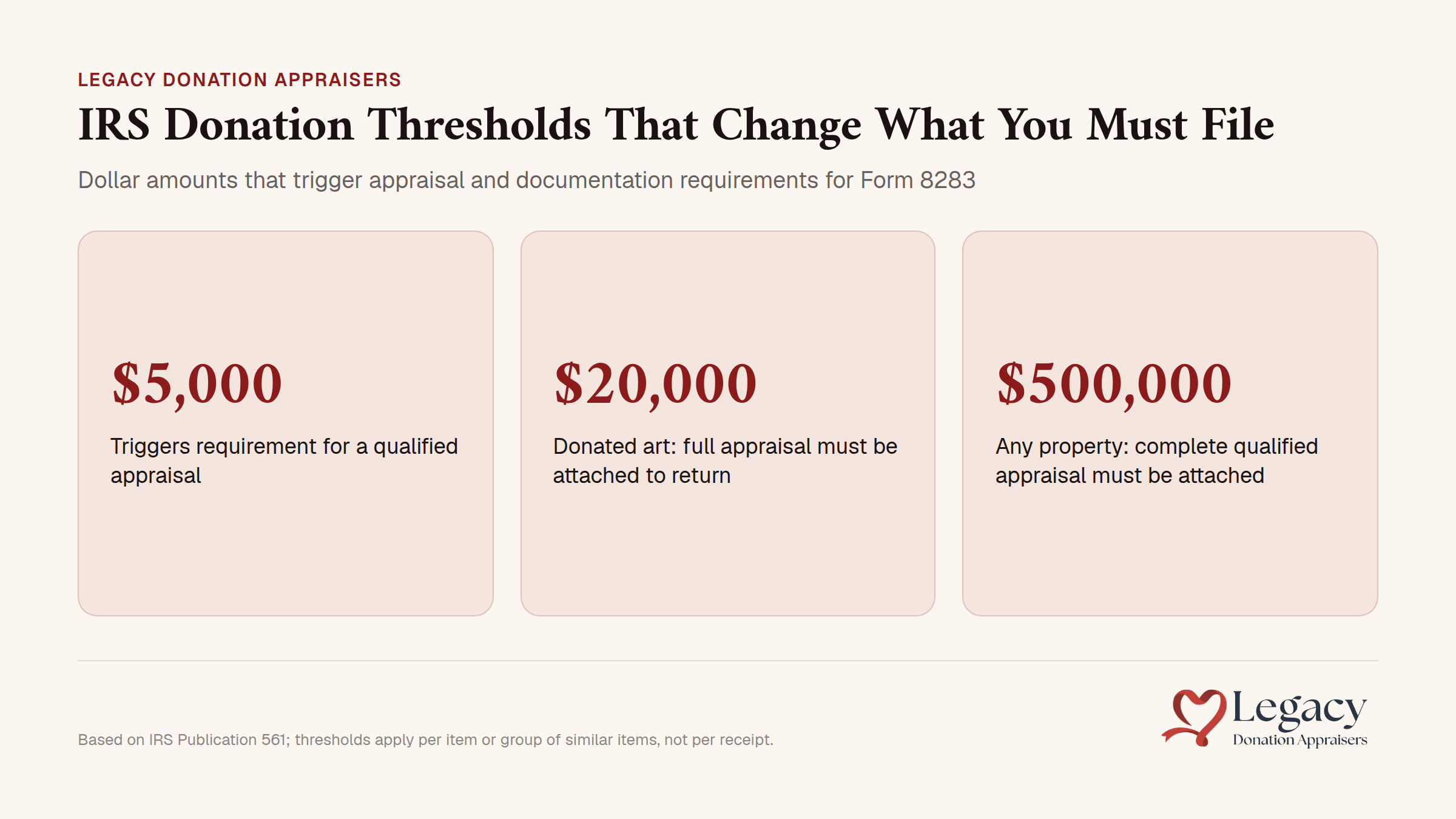
Three dollar thresholds determine how much documentation a donation requires: $5,000 triggers the qualified appraisal requirement itself, $20,000 for donated art requires attaching the full appraisal to your return, and $500,000 requires attaching the complete qualified appraisal regardless of property type. According to IRS Publication 561, these thresholds apply per item or group of similar items, not per donation receipt.
Timing matters just as much as the dollar amount. The appraisal's effective date of value cannot be more than 60 days before the date of the contribution, and the signed appraisal itself must be in hand no later than the due date of the return, including extensions, on which the deduction is first claimed. If the deduction is instead claimed on an amended return, the appraisal must be received before that amended return is filed.
Donors sometimes assume the $5,000 threshold applies only to a single receipt, but the ISA has noted that the IRS treats similar items as an aggregated category when calculating whether the threshold has been crossed. Five separate $1,200 donations of similar antiques in one tax year can add up to a qualified-appraisal requirement even though no single receipt looks large on its own. For a deeper breakdown of what pushes a donation past $5,000, our fine art appraisal for charitable donation page covers the art-specific $20,000 attachment rule in more detail, since art donations carry stricter documentation expectations than most other property types.
A Practical Checklist for Vetting an Appraiser Before You File
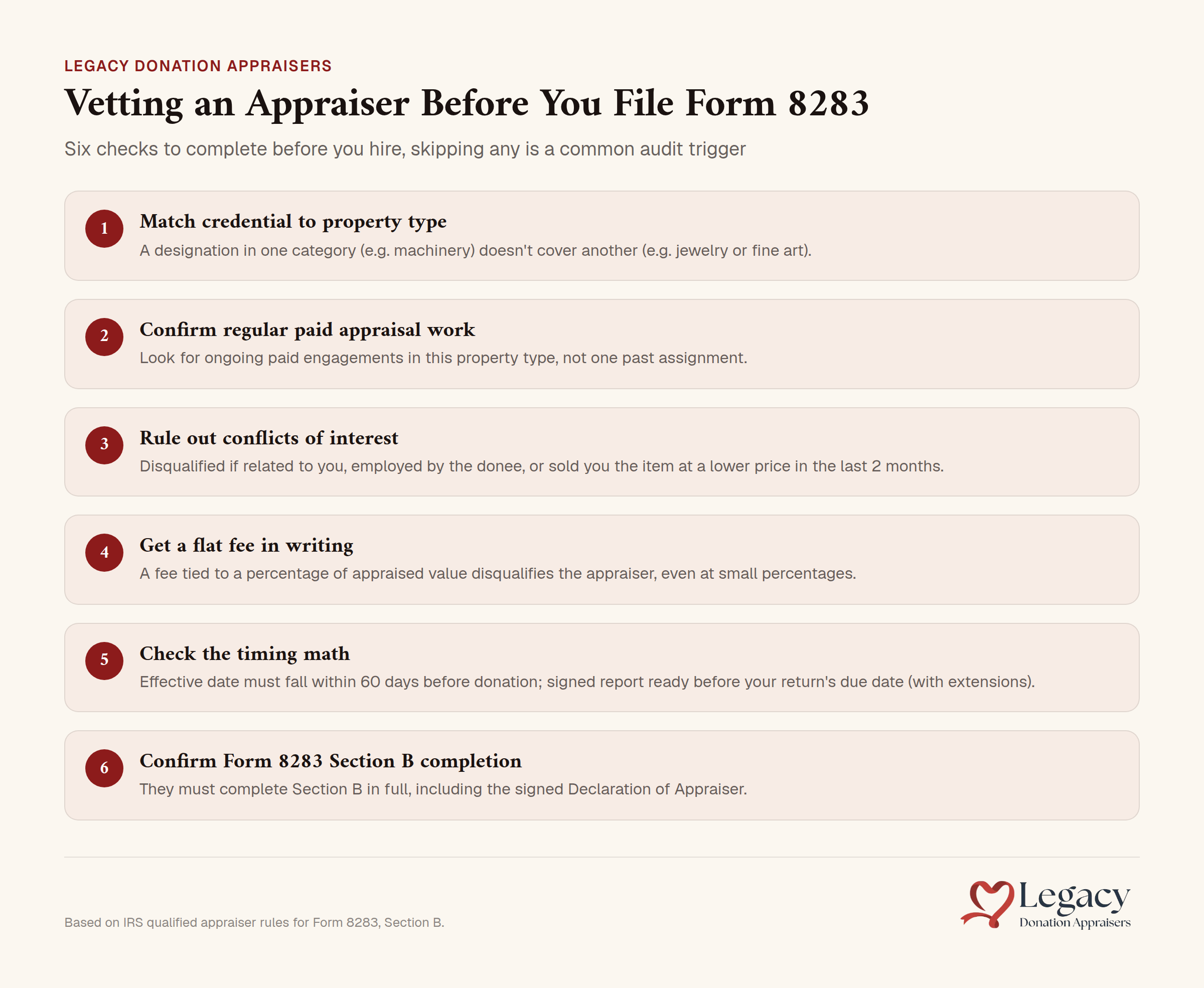
Before engaging an appraiser, confirm each of these points; skipping any one of them is a common reason the IRS challenges a donation appraisal later.
- Confirm the credential matches the property type. A designation in one category (say, machinery and equipment) does not carry over to another (say, jewelry or fine art).
- Ask about regular, paid appraisal work. The appraiser should be able to point to ongoing paid engagements in this property type, not a single past assignment.
- Rule out any relationship to you, the charity, or the item's history. If the appraiser is related to you, employed by the donee organization, or sold you the item within the last two months at a lower price, they cannot sign.
- Get the fee in writing as a flat rate. A fee tied to a percentage of the appraised value disqualifies the appraiser under IRS rules, no exceptions for small percentages.
- Check the timing math before you schedule. The appraisal's effective date needs to land within 60 days before your donation date, and the signed report needs to be ready before your return's due date, including extensions.
- Confirm they will complete Form 8283, Section B in full, including the signed Declaration of Appraiser, not just a standalone valuation letter.
Watch out: A beautifully formatted appraisal with a well-known signature is worthless to the IRS if the signer does not meet the qualification and independence tests above. Vet the person before you vet the paperwork.
Protect Your Deduction Before You File
The IRS does not evaluate whether your appraiser seems trustworthy; it evaluates whether they meet a specific, documented standard for education, experience, and independence. Getting this right before the engagement starts is far easier than trying to fix it after a donation has already been reported. If you want a report built to meet these requirements from the outset, our charitable donation appraisal services are structured around the exact documentation Form 8283 and Publication 561 require.
This article is provided for general informational purposes only and does not constitute legal, tax, or financial advice. Readers should consult a qualified attorney or CPA regarding their specific circumstances.