
Blog
Donating Musical Instruments and Pianos: When You Need a Qualified Appraisal
Donating a piano or musical instrument worth more than $5,000 triggers an IRS requirement for a qualified appraisal and Form 8283 Section B reporting. This guide explains the threshold, what actually drives an instrument's value, and why a USPAP-compliant appraisal protects your deduction.
Donating a piano, violin, guitar, or other musical instrument to a school, orchestra, or charitable organization is one of the more generous, and more complicated, gifts a taxpayer can make. Instrument values swing widely based on maker, age, condition, and the narrow market that actually buys them, so the IRS holds these donations to close scrutiny. Legacy Donation Appraisers prepares personal property appraisals for charitable donations covering instruments and pianos, and this guide walks through when a qualified appraisal is legally required, what drives an instrument's value, and why the appraisal needs to meet USPAP standards to hold up if the IRS looks closer.
When Does the IRS Require a Qualified Appraisal for a Donated Instrument?
A qualified appraisal is required whenever the claimed deduction for a musical instrument, or a group of similar instruments donated in the same year, exceeds $5,000. Below that threshold, the paperwork is lighter, but the value you claim still has to be supportable.
The IRS treats "similar items" as property of the same general category, so two violins or two pianos donated in the same tax year are added together for purposes of the $5,000 test, even if each one individually falls under the line. That aggregation rule catches a lot of donors off guard, especially musicians or collectors clearing out a studio. Our FAQ on the Form 8283 threshold walks through how the aggregation works in more detail.
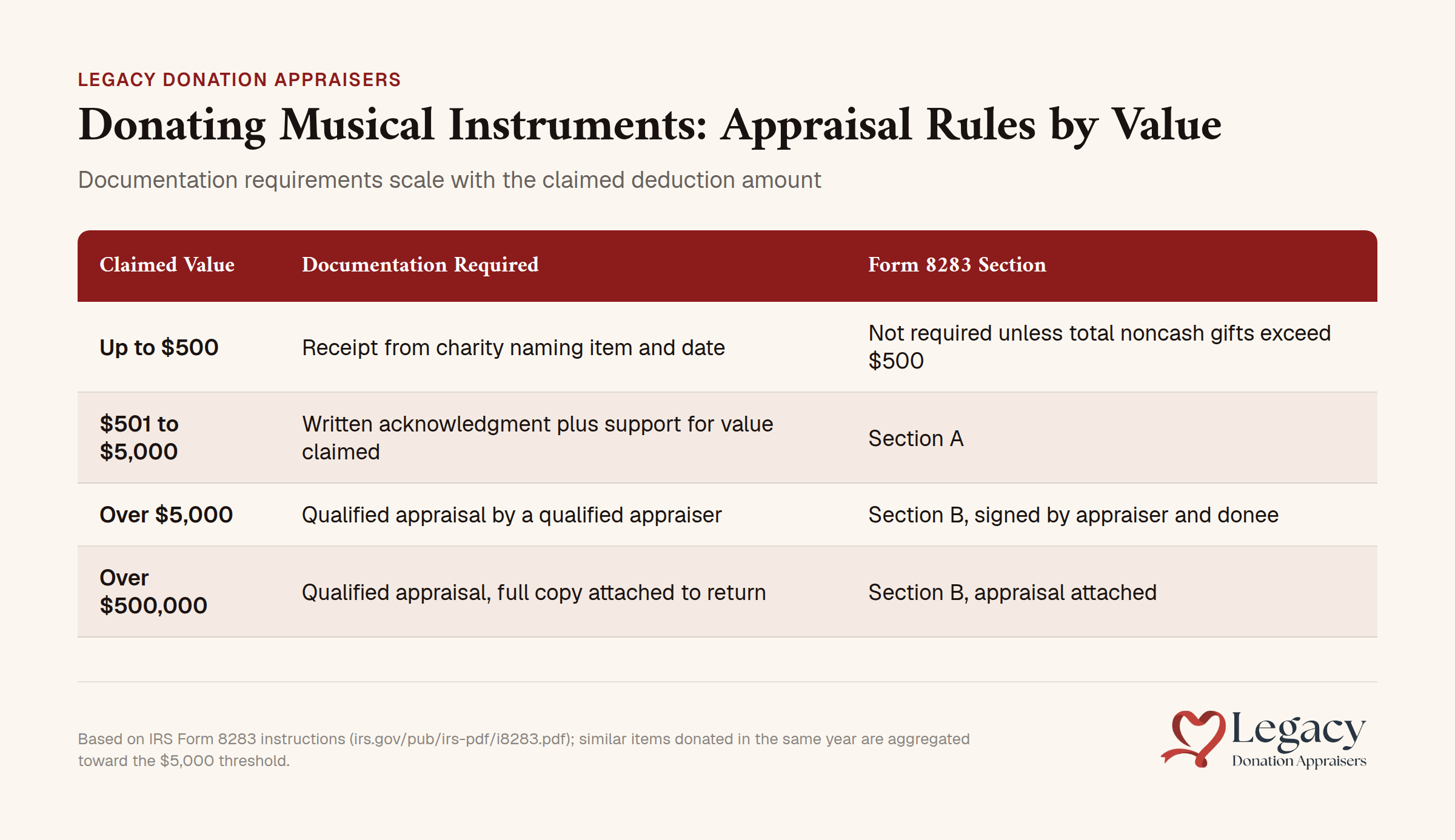
Here is how the requirements scale with the size of the donation:
| Claimed value | Documentation required | Form 8283 section |
|---|---|---|
| Up to $500 | Receipt from the charity naming the item and date | Not required unless total noncash gifts exceed $500 |
| $501 to $5,000 | Written acknowledgment plus support for the value claimed | Section A |
| Over $5,000 | Qualified appraisal by a qualified appraiser | Section B, signed by appraiser and donee |
| Over $500,000 | Qualified appraisal, full copy attached to the return | Section B, appraisal attached |
The IRS Form 8283 instructions spell out these tiers, and the same instructions require the donee organization to sign Part V of Section B acknowledging receipt of the item. For a full walkthrough of how to fill out the form itself, see our IRS Form 8283 guide.
What Form 8283 Requires for Instruments Over $5,000
Once a single instrument, or a group of similar instruments, crosses the $5,000 mark, Form 8283 becomes a document with real teeth. Section B has to be completed in full, and the form itself is not a substitute for the appraisal; it is a summary of one.
The IRS's guidance on substantiating noncash contributions confirms that for any noncash gift over $5,000 (other than publicly traded securities), the donor must attach Form 8283 and the donee must sign Section B, Part V. Skipping that donee signature is one of the more common reasons a deduction gets flagged for review.
A qualified appraisal itself has to include several specific elements:
- A detailed description of the instrument: maker, model, serial number, materials, notable repairs, and enough detail that someone unfamiliar with the piece could confirm it matches the donation.
- The date of contribution and a statement of fair market value as of that date, not the appraisal date or a future auction estimate.
- The valuation method used, including the comparable sales or market data the appraiser relied on.
- The appraiser's qualifications, including education, experience with musical instruments specifically, and any relevant professional credentials.
- A signed appraiser's declaration acknowledging the appraiser understands the penalties that apply to substantial valuation misstatements.
IRS Publication 561 defines fair market value in plain terms:
"The price at which property would change hands between a willing buyer and a willing seller, when neither is forced to buy or sell, and when both have reasonable knowledge of all relevant facts."
That standard, not insurance value, not replacement cost, and not what the donor originally paid, is the only number that belongs on the appraisal.
Watch out: A fee arrangement based on a percentage of the appraised value disqualifies the appraisal outright. Fees for a qualified appraisal have to be fixed or based on the scope of work, never tied to the number the appraiser reaches.
What Drives the Value of a Donated Piano or Instrument?
An instrument's fair market value comes down to what a real buyer in the actual secondary market for that instrument type would pay, not a retail sticker price or a family memory of what it cost new. Several factors do most of the work in that calculation:
- Maker and brand: A Steinway grand, a Bösendorfer, or an instrument from a recognized boutique luthier commands a materially different market than a generic student-line instrument, even at similar age and size.
- Age and design generation: For pianos especially, age interacts with design changes. Some vintage instruments hold strong rebuild value; others are functionally outdated regardless of brand.
- Condition and restoration history: Soundboard integrity, pinblock condition, action wear, and finish all matter. A piano that has been fully rebuilt by a reputable technician can be worth significantly more than a similar-age instrument that has only been lightly maintained, according to piano industry guidance on taking a tax deduction for a donated piano.
- Provenance and performance history: An instrument documented as having been used by a notable musician or in a significant recording or performance can carry intangible value beyond its physical condition, established through comparable sales of similarly pedigreed instruments.
- Market and location: Demand for a given instrument type varies by region, driven by the presence of conservatories, orchestras, and active dealer networks.
Example: A donor gives a 40-year-old upright piano that has never been serviced beyond basic tuning. A comparable instrument in similar condition might sell for $800 to $1,200 in the used piano market. If that same donor instead gives a fully rebuilt grand piano from a premium maker, with documented restoration work and a clean provenance, the fair market value could run into five figures, entirely on the strength of the rebuild and brand, not the age.
Appraisers separate physical characteristics (age, condition, brand) from intangible ones (provenance, historical significance) and explain how each factor moved the final number. A report that just states a dollar figure without that reasoning gives the IRS nothing to evaluate, and gives the donor nothing to defend.
Why USPAP Compliance Matters If the IRS Reviews Your Deduction
IRS Publication 561 requires that a qualified appraisal be made in accordance with the substance and principles of the Uniform Standards of Professional Appraisal Practice (USPAP), the standard published by The Appraisal Foundation. That is not a suggestion; it is written directly into what makes an appraisal "qualified" in the eyes of the IRS.
An appraisal that departs from USPAP principles, meaning it lacks credible market data, discloses no methodology, or reads like an advocacy piece for the donor's tax position, risks being disqualified entirely. If that happens, the IRS can deny the deduction outright, and both the donor and the appraiser can face penalties tied to substantial valuation misstatements.
Our appraisers hold credentials with organizations such as the International Society of Appraisers (ISA), the American Society of Appraisers (ASA), and the Appraisers Association of America (AAA), and every report we prepare for a charitable donation is completed in accordance with USPAP. That combination gives the appraisal three things an informal dealer letter or an online estimate never can:
- A documented, defensible methodology the IRS can actually evaluate, rather than a bare number.
- A signed appraiser declaration confirming the appraiser's specific qualifications to value musical instruments, satisfying the Form 8283 Part IV requirement.
- A fixed-fee structure that avoids the percentage-of-value arrangements the IRS explicitly disqualifies.
Key takeaway: The appraisal does not need to please the donor. It needs to survive a stranger reading it years later with no context, which is exactly the position an IRS examiner is in.
For instruments valued in the low thousands, a standard appraisal is often sufficient for the donor's own records. For anything approaching or exceeding the $5,000 threshold, an IRS-qualified appraisal is what Section B actually requires. Because fees are driven by the complexity of the instrument, the depth of research needed to document comparable sales, and whether the report needs to be IRS-qualified rather than a standard opinion of value, engagements are quoted as a fixed fee once we understand the scope, never billed hourly.
Timing Your Appraisal: The 60-Day Window
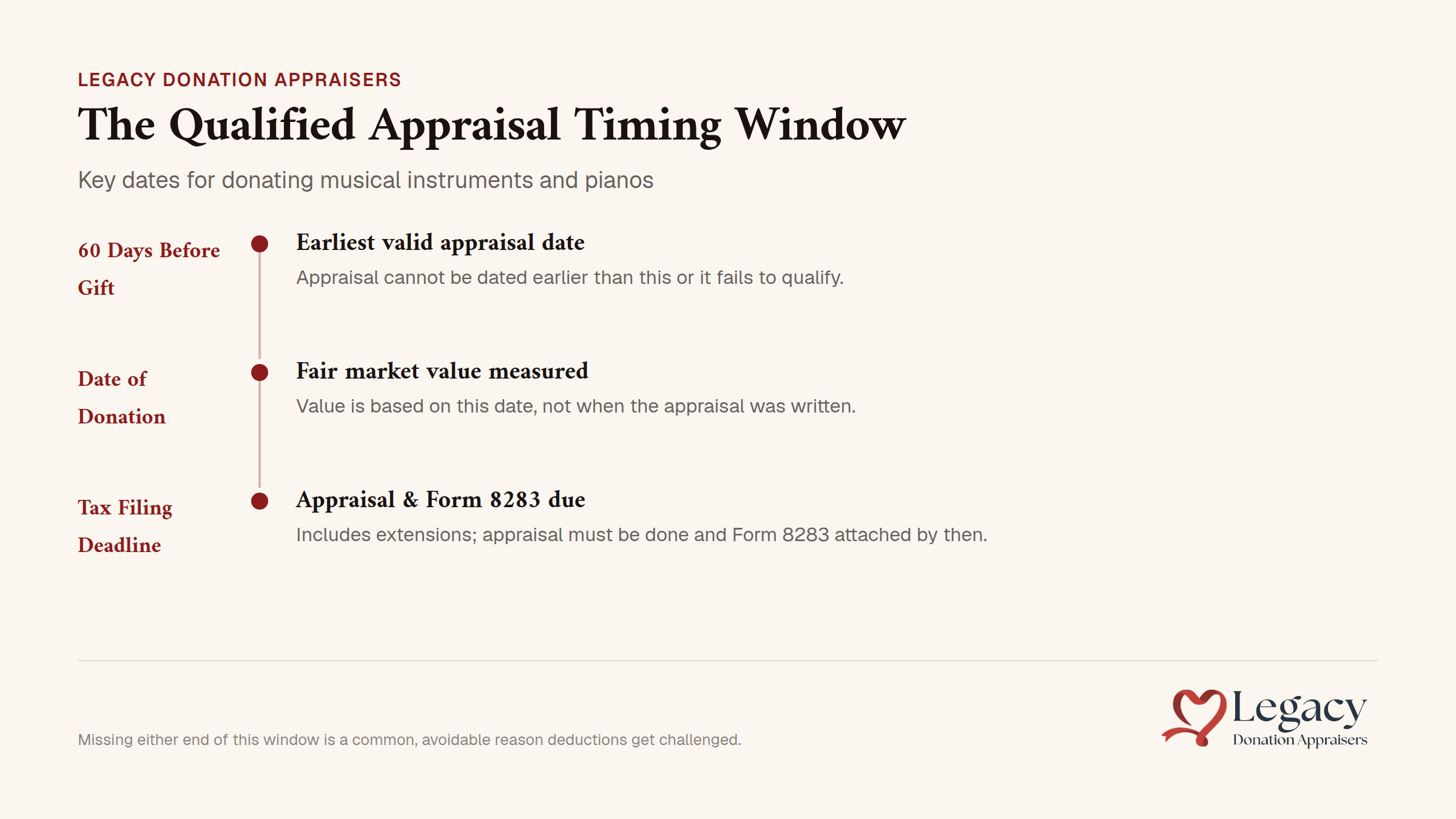
The appraisal has to be dated no earlier than 60 days before the date of the donation. An appraisal completed too far in advance of the gift does not satisfy the qualified appraisal requirement, even if nothing about the instrument changed in the interim.
On the other end, the appraisal must be completed by the due date, including extensions, of the tax return on which the deduction is first claimed. That gives donors a defined window: appraise the instrument close to the donation date, then file the return with Form 8283 attached before the deadline.
- 60 days before the gift: The earliest date an appraisal can be dated and still qualify.
- Date of donation: Fair market value is measured as of this date, not the appraisal date.
- Tax filing deadline (with extensions): The last date the qualified appraisal must be completed and Form 8283 attached.
Missing either end of that window is one of the more avoidable ways a deduction gets challenged. Scheduling the appraisal close to, but not exactly on, the donation date gives some breathing room without risking a stale valuation.
Getting the Documentation Right the First Time
A donated piano or instrument can generate a meaningful deduction, but only if the paperwork matches what the IRS actually requires. That means knowing whether the $5,000 threshold applies, completing Section B of Form 8283 correctly, and backing the claimed value with an appraisal that explains its reasoning rather than just stating a number.
Legacy Donation Appraisers prepares USPAP-compliant appraisals for donated musical instruments and pianos, built to stand up to IRS review from the day they're written. If you're planning a donation and want the valuation done right the first time, our team can scope the assignment and quote a fixed fee before any work begins.
This article is provided for general informational purposes only and does not constitute legal, tax, or financial advice. Readers should consult a qualified attorney or CPA regarding their specific circumstances.